
THE VERDURE ARCHIVE
Crystal Anthurium
Anthurium crystallinum
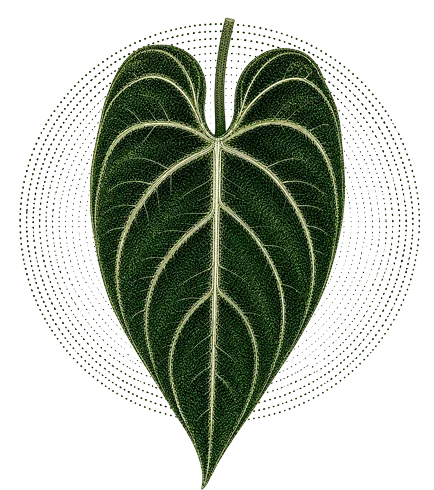
Silver veins across a heart of green.
No leaf catches light quite like Anthurium Crystallinum.
Born in the cool, humid air of Central and South American cloud forests, it exists at the threshold of biology and optics—a plant whose surface seems built to capture light.
This is not simply a plant.
It is a study in form as luminance—where microscopic surface structures, deep green tissue, and silver veining converge into something quietly extraordinary.
History
First described in the 19th century by European botanists exploring South America, Anthurium Crystallinum remained rare in cultivation for decades.
Recent decades have seen it move from botanical-garden specimen to design-forward collector's plant—one of the slow icons of contemporary aroid culture.
Presence
It rewards close attention.
The veining only reveals its full luminance at close distance—making it a plant that draws people in, slowing the pace of a space and inviting a quieter kind of looking.
Native Range
Central and northern South America — from Panama through Colombia into Peru
Natural Habitat
Cool, humid cloud forests — often on tree trunks or shaded forest floors
Growth Behavior
Slow-growing epiphyte — anchoring to bark and moss, leaves emerging bronze and maturing to deep green
Insight
The crystal sheen isn't pigment.
Microscopic surface structures scatter light across the leaf, producing the silvery veining that gives the plant its name — a study in how form quietly becomes optics.